
Naval architecture support for vessels being designed, modified, repaired or assessed, including hull form, hydrostatics, stability, weight control, powering, structures and trials.
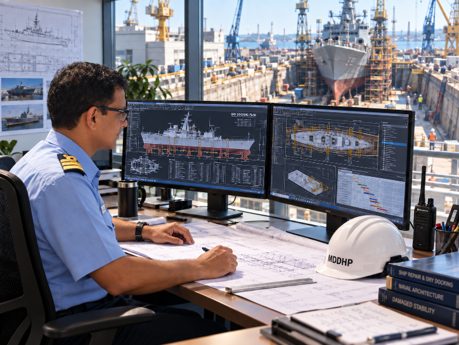
Naval architecture determines how a vessel floats, how much it can carry, how it responds to heel, how much stability margin it has, how much power it needs and whether its structure can safely carry the applied loads.
I work on that layer of a project. New designs, modifications to vessels already in service, and older craft where the paperwork no longer matches what is actually in the water. The work runs from a single weight-change assessment to a full stability package with an inclining experiment and a sealed booklet.
Twenty years across design offices, shipyards and dry docks sits behind every calculation. That means the answer you get accounts for how the vessel will be built, surveyed and operated — not only how it performs on paper.
Five areas of work. Most projects use two or three of them together, and every engagement is scoped and priced before it starts.
01
The geometry everything else depends on
A defensible 3D model of the hull and its components. Built from existing drawings where they exist, or recovered from a lines take-off and measured survey where they don't which is common on older small craft.
Lines plans and offset development
Hull surface modelling
Hydrostatics
Bonjean curves where required
Tank and compartment definition
Lines take-off / geometry recovery where suitable information is not available
Before and after anything goes on the vessel
Intact and large-angle stability against the criteria that apply to your vessel and service, assessed in the loading conditions it actually operates in. Where the light ship condition is unknown or out of date, an inclining experiment gives you a real number rather than an assumption.
Intact stability
Large-angle stability where applicable
Downflooding assessment
Loading conditions
Weight and centre-of-gravity control
Inclining experiments
Stability booklets and supporting calculations
Speed, fuel and machinery selection
What the hull will cost you in power, and whether the machinery being proposed will deliver the speed the operation needs. Useful during concept design, repowering, and when a modification adds displacement or drag that nobody has accounted for.
Resistance estimates
Powering predictions
Assessment of the effect of modifications on performance
Proving the vessel does what the calculations say
Planning, attending and reporting the trials that close out a build, a refit or a compliance requirement. Procedures written so the yard, the crew and the surveyor all agree in advance on what is being measured and what counts as a pass.
Trial procedures
Inclining experiment supervision
Speed and manoeuvring trials
Attendance / witnessing where required
Trial reporting and technical close-out
Making a modification carry its load
Scantling checks and local analysis for modifications, foundations and repairs — crane and davit seats, deck penetrations, added structure, insert plates and doublers. Finite element analysis where a detail genuinely warrants it, and hand calculations where it does not.
Scantling checks
Local structural modification calculations
Equipment foundations and seats
Repair details
Local finite element analysis where justified
Steel and aluminium structural details
You are not buying a firm's capacity. You are buying twenty years of judgement from the person who will do the work, review it and put a seal on it.
P.Eng. review and stamping for eligible vessels under my Ontario licence and Certificate of Authorization not subcontracted to a name you never speak to.
Design offices, shipyards, dry docks and trials. Calculations are written for the people who have to build, survey and operate the vessel.
Deliverables, assumptions, timeline and price agreed in writing. Changes are agreed before they are done, not billed afterwards.
If a criterion is going to fail or a modification will not work as drawn, you hear it during the analysis with the options laid out not in the final report.
One phone number, one email, no account manager and no explaining your vessel a second time.
We will support reasonable technical clarification of the engineering issued. If a reviewer requests additional analysis or work outside the agreed scope, we will discuss that with the client before proceeding.
Vessel length and service, the general arrangement if you have it, what is being added or modified, and any stability data you already hold. I will come back with a scope, a timeline and a price or a straight answer that it is not work I should take.
I can provide P.Eng. review and stamping for eligible vessels under 24 m, under my Ontario licence and Certificate of Authorization. Eligibility depends on the vessel's size, service and the regime it falls under. Send the particulars and I will tell you plainly before you commit to anything.
It is common and it is workable. The hull can be recovered from a measured survey or lines take-off, and the light ship condition from an inclining experiment. It adds a site visit to the scope, and that will be in the quote rather than discovered halfway through.
A straightforward modification assessment on a vessel with good drawings is usually weeks. A full stability booklet with an inclining experiment depends mainly on when the vessel can be made available in a suitable condition. You get a date in the quote and early warning if anything threatens it.
Then you hear it from me rather than from a surveyor or from the sea. Where a vessel does not meet criteria, the report says so and sets out the options — operating restrictions, ballast, weight removal, structural or arrangement changes — with the engineering behind each one.
Engineering and analysis work goes anywhere. Sealed deliverables depend on the licensing rules of the province the work is for, so tell me where the vessel operates and I will confirm what I can and cannot seal before starting.
For work beyond my own capacity or specialist discipline, I can bring in suitable engineering or drafting support through established collaborators. The role, responsibility and deliverables will be clear to the client before the work starts.

Address : Hamilton, Ontario, Canada
Email : info@builtforsea.com