
Engineering support for Canadian vessel compliance, technical review, stability testing and documentation. Engineering review and sealing can be provided where the work is within the professional scope and permitted by the applicable requirement.
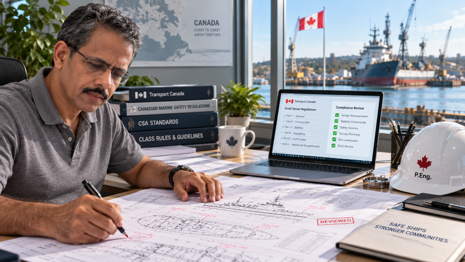
Compliance work needs both sound engineering and clear documentation. BuiltForSea can support the calculations, testing, technical review and documentation required for the applicable vessel and service.
This service covers that gap. I review designs for eligible vessels, run the physical tests those regimes call for, and prepare compliance documentation that a reviewer can follow from the first assumption to the final number.
The work applies equally to new builds heading into service, existing vessels that have been modified over the years, and boats being moved into a different service or operating area — where the requirements change even though the hull hasn't.
Before you spend anything: send me the vessel particulars and the intended service, and I will tell you which regime applies and whether it is work I can seal. That answer is free and it is honest, including when the answer is no.
Four areas of work that usually travel together. A new build often needs all four; a modified vessel in service may need only one.
01
A licensed engineer's review on eligible vessels under 24 m
Independent review of design and modification work against the standards applying to your vessel, followed by a seal where the engineering supports it.
P. Eng. review and stamping for submission to TCMSS
Getting the vessel and the file ready together
SVCP asks an owner to declare that a vessel meets the construction, stability and safety requirements for its service. Making that declaration honestly needs engineering behind it. I assess the vessel against the applicable requirements, identify what is missing, and prepare the technical evidence that supports the submission.
Physical proof, witnessed and reported
The tests that replace assumptions with measurements. An inclining experiment establishes the real light-ship weight and centre of gravity; swamp and static deflection tests demonstrate the flotation and structural behaviour that small-craft regimes require. Procedures are written in advance so everyone agrees beforehand on what is measured and what counts as a pass.
The numbers and the file that go with the vessel
Tonnage decides which regime a vessel falls under, so it is worth getting right before anything else is designed around it. Alongside it, the document set a vessel carries through its working life: stability booklets, compliance matrices, technical submissions and vessel-specific safety management documentation.
Tonnage calculation and measurement support
MSMSR safety management documentation
MARPOL and SOLAS compliance support, where applicable.
05
BuiltForSea can support the development and review of vessel-specific Safety Management System documentation, including applicability/readiness review, operational procedures, risk controls, emergency procedures, maintenance interfaces, document control and audit/readiness support. The exact scope will depend on the vessel, operation and applicable Transport Canada requirements.
Stamping work carries personal liability for the engineer who signs it. That is exactly why you want the person who did the calculations to be the person who seals them.
P.Eng. #100561675 and PEO Certificate of Authorization #100694276. The licence sits with the engineer you are speaking to.
If your vessel falls outside what I can properly review or seal, you find that out in the first conversation, before any money changes hands.
Assumptions stated, methods shown, numbers reproducible. Documentation is written for the person who has to accept it.
Inclining, swamp and deflection tests, the stability work behind them and the submission itself — handled together, not across three suppliers.
My career experience includes vessel inspection, trials, compliance-related engineering and technical documentation across naval, commercial and small-vessel work.
If a question comes back on a package I issued, answering it is part of the job rather than a new invoice.
Length, tonnage if known, hull material, how many people it carries, where it operates and what has been asked of you. I will confirm which regime applies, what evidence it needs, and what I can seal — then quote a scope against that.
Address : Hamilton, Ontario, Canada
Email : info@builtforsea.com