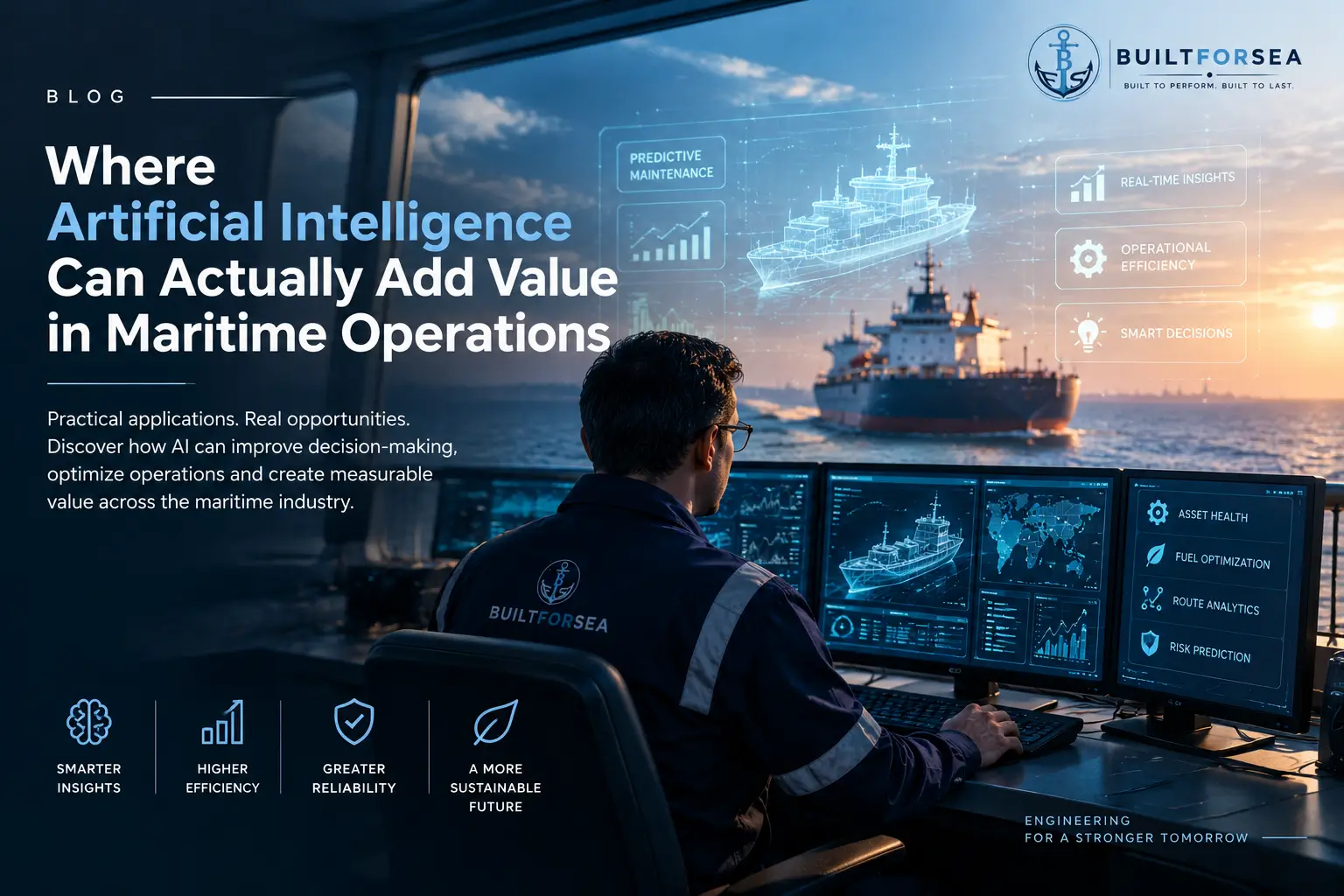
Artificial intelligence is increasingly being discussed across the maritime industry. But the value of AI does not come from simply adding technology to an existing workflow.
For vessel owners, operators, shipyards and engineering teams, the more important question is: Where can AI solve a real operational or engineering problem?
The strongest applications are likely to be those that improve access to information, support technical decision-making and reduce repetitive work.
Turning technical information into usable insight
Maritime organisations generate significant amounts of technical information.
Maintenance records, inspection reports, drawings, defect lists, equipment histories and operational data can become difficult to manage as projects and fleets grow.
AI can help organize and interpret large volumes of information, allowing teams to find relevant records and identify relationships more efficiently.
Supporting maintenance decisions
AI can also support condition-based maintenance by helping teams identify patterns in historical and operational data.
Instead of relying solely on fixed maintenance intervals, organisations can potentially use available data to identify equipment behaviour, recurring issues or areas requiring closer attention.
AI should support engineering judgement rather than replace it.
Improving inspection workflows
Inspection activities generate valuable information, but converting observations into consistent reports can be time-consuming.
AI-assisted tools may help with information classification, report preparation, defect tracking and comparison of historical findings.
The final engineering assessment, however, should remain subject to appropriate professional review.
Supporting shipyard and project delivery
AI can also be useful beyond vessel operations.
During complex refit or construction projects, teams work with large quantities of documentation, correspondence, schedules and technical information.
AI-based information tools can help teams locate relevant documents, summarize project information and identify outstanding actions more efficiently.
The importance of responsible implementation
Technology should be introduced around a clearly defined business or engineering problem.
Before implementing an AI solution, organisations should consider:
- Data quality
- Information security
- System integration
- Human oversight
- Regulatory considerations
- Accuracy and traceability
- Ownership of decisions
The goal should not be “AI for AI’s sake.” The goal should be better information, better workflows and better decisions.
Conclusion
AI has meaningful potential across maritime engineering and operations, but successful adoption requires a practical approach.
The most valuable solutions will be those that integrate into existing workflows and help experienced professionals work more effectively.
For maritime organisations, the opportunity is not to replace engineering expertise with AI. It is to augment engineering expertise with better access to information and smarter digital tools.